
How to Achieve a Prop Firm Evaluation: The Complete Discipline Guide
Let's kill a myth: you don't need a winning strategy to pass a prop firm evaluation. You need a strategy that doesn't lose too much.
That distinction matters more than most traders realize. Evaluations aren't won by the trader with the best entries — they're won by the trader who protects their account through drawdowns, stays patient during slow markets, and executes a boring, repeatable process day after day.
This guide breaks down the three pillars that every funded trader we've spoken to credits for their success: discipline, risk control, and patience.
Pillar 1: Trading Discipline
Discipline is the gap between knowing what to do and actually doing it. Every trader knows they shouldn't chase entries. Every trader knows they should honor their stop loss. But under the pressure of a ticking evaluation, that knowledge evaporates.
Building discipline requires systems, not willpower. Willpower is a depleting resource — it runs out precisely when you need it most (after a string of losses, during a volatile news event, at the end of a long session). Systems, on the other hand, operate regardless of your emotional state.
- Pre-session checklist: Before every session, write down your maximum trade count, your maximum loss for the day, and the specific setups you're looking for. This is your contract with yourself.
- Trade journal: Log every trade immediately after closing it. Include not just the P&L, but a 1-10 rating of how well you followed your rules. Over time, you'll find that high-discipline trades are your most profitable.
- Accountability system: Share your daily plan with a trading partner, a Discord group, or even just a spreadsheet. External accountability reinforces internal discipline.
- Simulation practice: Use tools like the Do Not Trade Simulator to train your discipline muscle outside of live markets. Recognizing when NOT to trade is the hardest skill to build.
The #1 discipline hack used by funded traders: set a physical timer for 5 minutes before entering any trade. If after 5 minutes you still want the trade and it still meets your criteria, take it. You'll be amazed how many impulsive trades this eliminates.
Pillar 2: Risk Control
Risk management in an evaluation isn't about maximizing profits — it's about surviving long enough to let your edge play out. The math is unforgiving: a 50% drawdown requires a 100% gain to recover. A 20% drawdown requires a 25% gain. Preservation is mathematically more powerful than aggression.
Here's the risk framework that funded traders use:
- Risk per trade: Never exceed 1% of your evaluation account per trade. On a $50K account (see the cheapest 50K evaluations), that's $500 max risk.
- Daily loss limit: Set a personal daily stop-loss at 50% of your firm's maximum allowed drawdown. If the firm allows $2,000 daily loss, your personal limit is $1,000.
- Weekly target: Aim for small, consistent gains (1-2% per week) rather than home runs. Evaluations reward consistency.
- Position sizing: Calculate your position size BEFORE entering. Never add to a losing position during an evaluation.
- Correlation awareness: Avoid taking multiple positions in correlated instruments. Two NQ longs is effectively one position at double the risk.
Do Not Trade Simulator
Can you tell a real setup from a trap? Practice identifying liquidity sweeps, fake breakouts, and valid entries in a risk-free environment. Your discipline score reveals your true trading edge.
The most common risk management failure in evaluations: traders who are profitable for 3 weeks suddenly increase their position size to "finish fast." This almost always results in giving back their profits. Maintain consistent sizing throughout the entire evaluation.
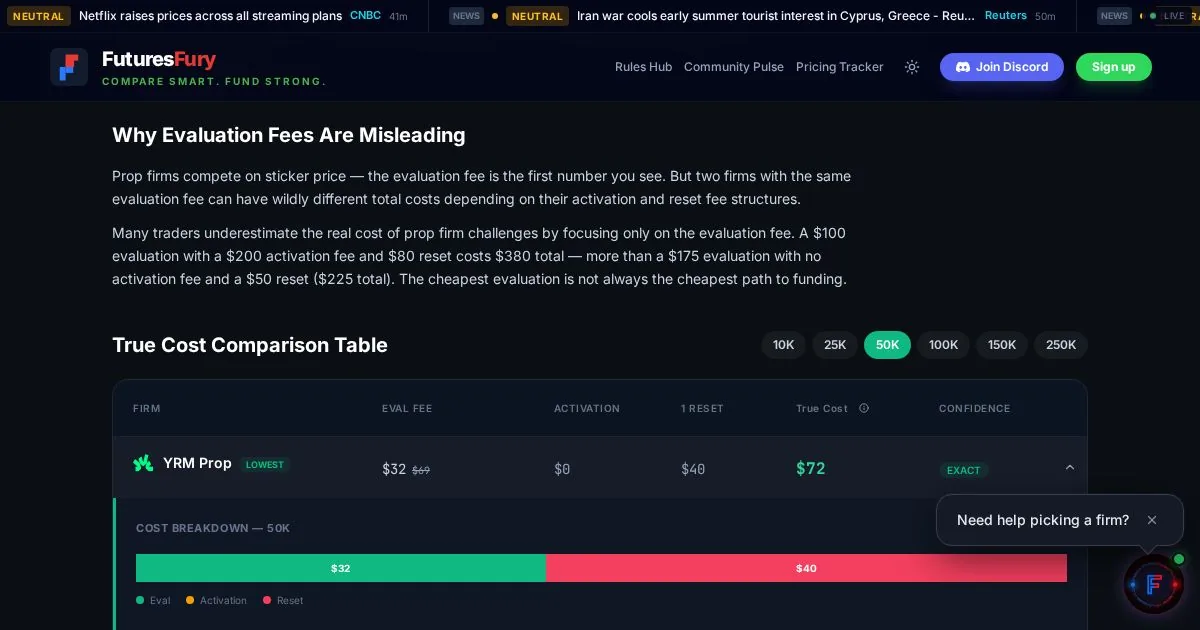
Different prop firms have different rules and drawdown structures. Understanding your specific firm's rules before you start trading is non-negotiable. A trailing drawdown behaves very differently from an end-of-day drawdown, and misunderstanding this distinction has ended thousands of evaluations.
Pillar 3: Patience
Patience is the most underrated trading skill because it's invisible. Nobody posts screenshots of the trades they didn't take. But the professionals know: the money is made in the waiting.
In an evaluation, patience manifests in three ways:
- Session patience: Waiting for your specific setup to appear instead of forcing trades in suboptimal conditions. Some days, the right setup never comes — and that's okay.
- Evaluation patience: Accepting that the evaluation will take as long as it takes. Rushing the process by increasing size or trading more frequently is the fastest path to failure.
- Outcome patience: Detaching from the P&L of individual trades and focusing on whether you followed your process. Results are a lagging indicator of process quality.
The traders who struggle most with patience are often the most skilled technically. They can read charts, identify patterns, and find setups — which means they see "opportunities" everywhere. But an opportunity that doesn't meet every criterion on your checklist isn't an opportunity. It's a trap.
The 10-Day Evaluation Framework
Here's a practical, day-by-day approach for your first evaluation:
- Days 1-2: Trade minimum size only. Your goal is to learn the platform and get comfortable with the account, not to make money.
- Days 3-5: Trade your normal strategy at 50% of your maximum allowed risk. Focus on execution quality and rule-following.
- Days 6-8: Increase to full risk parameters if Days 3-5 were profitable and disciplined. If not, stay at 50% risk.
- Days 9-10: Maintain your approach. Do NOT increase size or frequency to "catch up" or "finish early."
- Throughout: Journal every trade, review daily, and take at least one full day off per week.
This framework won't produce viral trading screenshots. It won't make you a social media star. But it will systematically put you in the best position to pass your evaluation and get funded. Firms like Blue Guardian pair well with this approach — their EOD trailing drawdown gives you room to survive the inevitable rough days.
Ready to find the right evaluation for your style and budget? Compare all options at our best futures prop firms page, use the full comparison table to sort by drawdown type and cost, or search for active discount codes to save on your evaluation fee. First-time evaluators should start with the beginner's guide to find the most forgiving options.
Frequently Asked Questions
How do you pass a prop firm evaluation?
What is the pass rate for prop firm evaluations?
How many trading days should I plan for?
What rules should I know before starting?
Which prop firm is easiest to pass?
Keep Reading
Guides and reviews related to this article
Blue Guardian Review
EOD trailing drawdown gives room to survive rough days
Elite Trader Funding Review
established brand with documented payout history
What Is Trailing Drawdown?
understand the drawdown model that matters most
What Is EOD Drawdown?
why end-of-day drawdown is more forgiving
Why Most Traders Fail Evaluations
the 5 fatal behavioral mistakes
Trading Discipline Exercises
7 practical drills to build your edge
How to Practice Trading Without Risking Money
build pattern recognition before you risk capital
Fake Breakouts in Futures Trading
the #1 pattern that breaches drawdown limits
Prop Firm Skill-Level Decision Guide
match your skill bracket to the right rule set
Firms Mentioned
Comments (0)
No comments yet. Be the first to share your thoughts!