
Trading Discipline Exercises for Futures Traders
Here's an uncomfortable truth: most traders know what discipline looks like but can't execute it when it matters. They can explain why overtrading is bad, describe perfect risk management, and recite the importance of patience. Then they blow their evaluation account on the third day because they took seven trades during a choppy lunch session.
The gap between knowing and doing is a training gap. And just like physical fitness, trading discipline responds to specific, deliberate exercises. You wouldn't run a marathon without training — so why attempt a prop firm evaluation without training your discipline? Choosing the right firm matters too — our beginner's guide highlights the most forgiving options.
Here are seven exercises that professional futures traders use to build and maintain their discipline edge.
Exercise 1: The Patience Timer
Open your charting platform at market open. Set a physical timer for 30 minutes. During those 30 minutes, your only job is to observe. No trades. No orders. No hovering over the buy button. Just watch.
Sound easy? It's excruciating — especially during a volatile open when price is swinging 10+ points and every candle looks like a missed opportunity.
But this exercise teaches you something critical: the market doesn't owe you a setup in the first 30 minutes. The opening range is typically the most chaotic, highest-spread, widest-slippage period of the session. By observing instead of trading, you develop the neural pathway for "watching without acting" — the foundation of all trading discipline.
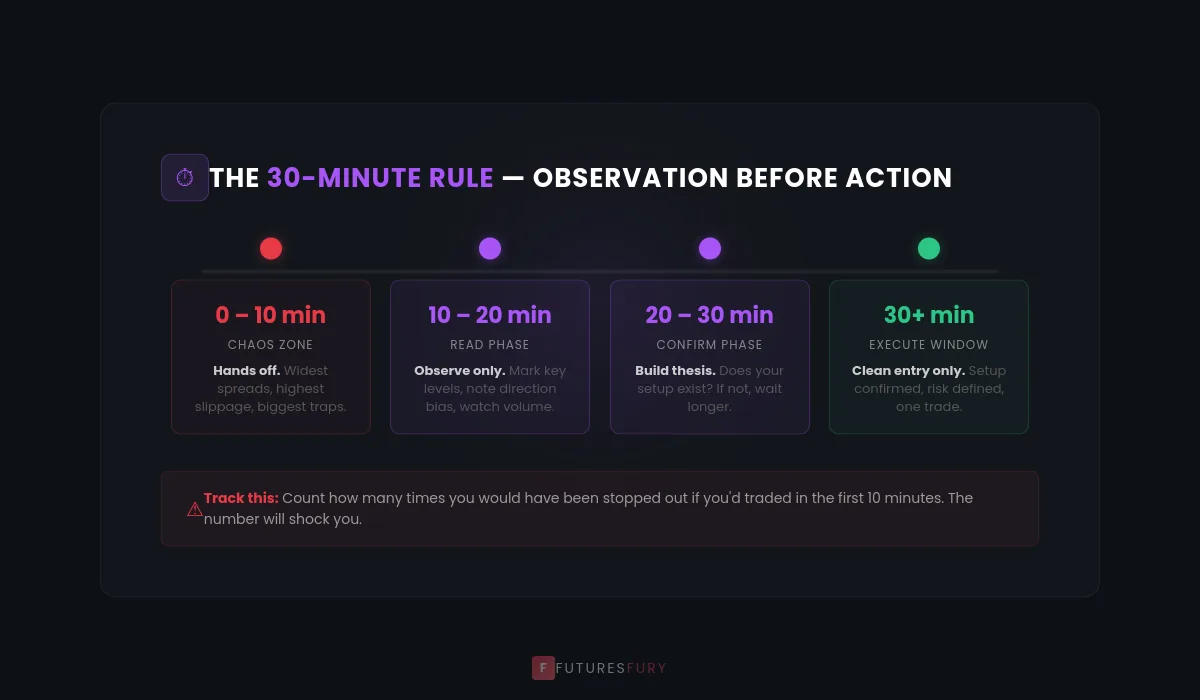
Progression: Start with 30 minutes for the first week. Extend to 45 minutes in week two, then 60 minutes. Document how many times during your observation period you would have been stopped out if you'd traded impulsively. The number will shock you.
Exercise 2: The Trap Identification Drill
This is where simulation tools become invaluable. Open the Do Not Trade Simulator and play through 10 scenarios. For each scenario, before making your decision, write down:
- What type of setup is this? (Valid entry, trap, or no setup)
- Where is price relative to VWAP?
- Are there any liquidity sweeps or fake breakout signals?
- What would happen if you entered here and price reversed?
The key to this exercise is the writing. Forcing yourself to articulate your reasoning before clicking a button slows down your decision-making process — which is exactly what you need. Impulsive trading thrives on speed; discipline requires deliberation.
Do Not Trade Simulator
Can you tell a real setup from a trap? Practice identifying liquidity sweeps, fake breakouts, and valid entries in a risk-free environment. Your discipline score reveals your true trading edge.
Exercise 3: The Zero-Trade Day
Once per week, open your platform with the explicit intention of taking zero trades. Watch the entire session. Mark setups you see. Write down what you would have traded and why. But don't execute a single order.
This exercise directly attacks the "action bias" that plagues most traders. Our brains are wired to equate action with progress. In trading, the opposite is true: the best sessions are often the ones where you traded the least.
After your zero-trade day, review your notes. Calculate what your P&L would have been if you'd taken those trades. You'll likely find that the hypothetical result was worse than zero — confirming that inaction was the profitable choice.
Exercise 4: The 3-Strike Rule
Implement a hard rule for one full trading week: after 3 trades in a single session, you're done. No exceptions.
This constraint forces you to be incredibly selective. With only 3 trades available, you can't afford to waste one on a marginal setup. Every entry must meet your highest-quality criteria.
- Trade 1: Your highest conviction setup of the session
- Trade 2: Only if Trade 1 is closed and a fresh A+ setup appears
- Trade 3: Emergency reserve — only used if an exceptional opportunity presents itself
- After Trade 3: Platform closed. Day is over. No matter what happens in the market.
Most traders discover that the 3-strike constraint actually improves their results. Fewer trades means less commission drag, less emotional fatigue, and higher average quality per trade. Understanding these constraints mirrors the rules at top prop firms where consistency matters more than volume. See how firms compare on consistency rules to find one that matches your style.
Exercise 5: The Pre-Trade Commitment Contract
Before each session, write a physical note card (not digital — the act of writing matters) with three pieces of information:
- My maximum loss today is $____ (50% of your firm's daily limit)
- My maximum number of trades today is ____ (2-4 for most strategies)
- The only setups I will trade today are ____ (be specific — e.g., "VWAP rejection with FVG confirmation above session open")
Place this card next to your monitor where you can see it. Every time you're about to place a trade, read the card first. If the trade doesn't match what's on the card, you don't take it. Period.
This exercise leverages the psychology of commitment and consistency. Humans are deeply motivated to act consistently with commitments they've made, especially written ones. The card acts as an external discipline anchor when your internal discipline wavers.
Exercise 6: The Post-Loss Protocol
Design a mandatory protocol for what happens after every losing trade. This removes decision-making from the equation during your most emotionally vulnerable moments.
Here's an example protocol:
- Step 1: Close the platform immediately after the trade closes
- Step 2: Open your journal and write exactly what happened — entry reason, what went wrong, and whether you followed your rules
- Step 3: Set a timer for 15 minutes. During this time, do something physical — walk, stretch, do pushups
- Step 4: After the timer, review the chart. If your setup criteria are still met, you may look for another entry. If not, you're done for the session.
The biggest mistake traders make after a loss is immediately scanning for another trade to "make it back." This revenge-trading impulse has destroyed more prop firm accounts than any market condition. If you've had to reset, grab a discount code before repurchasing. Your post-loss protocol is your firewall against this impulse.
Exercise 7: The Weekly Discipline Scorecard
At the end of each week, score yourself on five dimensions:
- Setup quality (1-10): Did I only take A+ setups?
- Risk adherence (1-10): Did I honor my position sizing and stop losses?
- Patience (1-10): Did I wait for setups instead of forcing them?
- Emotional control (1-10): Did I avoid revenge trading and FOMO entries?
- Process consistency (1-10): Did I follow my pre-session and post-trade routines?
Your discipline score should trend upward over weeks. If it doesn't, identify the weakest dimension and design a focused exercise for that area — professionals improve by systematically strengthening their weakest link, not by trying to fix everything at once.
Trading discipline is a trained skill. Combine these exercises with daily practice on the Do Not Trade Simulator, apply them during your evaluation at a firm like Bulenox, and you'll be ahead of the vast majority of traders who rely on willpower alone.
Discipline gets you funded — but trusting your firm keeps you going. See which firms are actually paying out on our Payout Status Tracker, read what real traders are saying on Community Pulse, or check for active discount codes to keep your evaluation cost low.
Frequently Asked Questions
How do you build trading discipline?
What is the 3-strike rule in trading?
Can you practice discipline without real money?
How important is discipline vs strategy in prop trading?
What is a zero-trade day exercise?
Keep Reading
Guides and reviews related to this article
Bulenox Review
beginner-friendly with flexible drawdown choices
BluSky Trading Review
fast payouts and clean rule set
What Is the Consistency Rule?
understand the rule that trips up most traders
Is Bulenox Worth It?
quick verdict with honest pros and cons
Fake Breakouts in Futures Trading
spot liquidity sweeps before they trap you
How to Pass a Prop Firm Evaluation
discipline, risk control, and patience
Comments (0)
No comments yet. Be the first to share your thoughts!