Why Most Prop Firm Traders Fail Evaluations
The failure rate in prop firm evaluations is staggering. Industry estimates suggest that over 80% of traders who attempt a funded evaluation never pass. But here's the truth most traders don't want to hear: the problem almost never is a lack of market knowledge. It's a lack of discipline.
After analyzing thousands of evaluation attempts and speaking with prop firm risk managers, we've identified the five most common reasons traders blow their evaluations — and every single one is a behavioral problem, not a technical one.
The #1 Problem: Overtrading
Overtrading is the single biggest account killer in prop firm evaluations. It manifests in two ways: taking too many trades per session, and trading during low-quality market conditions.
When a trader enters an evaluation, there's an invisible psychological pressure to "make it happen." You've paid a fee. The clock is ticking. And every session without a trade feels like a wasted day. This urgency leads traders to force entries where none exist — jumping into choppy, range-bound markets or stacking trades during low-volume hours.
The fix is simple but painful: set a maximum of 2-3 trades per session. If you don't see a clean setup within your first 90 minutes, close the platform. The evaluation isn't going anywhere — but your account balance will if you force trades.
Professional traders at top prop firms like Bulenox and BluSky Trading report that their best months often have the fewest trades. Quality over quantity isn't just a cliché — it's the mathematical edge that separates funded traders from blown accounts.
Do Not Trade Simulator
Can you tell a real setup from a trap? Practice identifying liquidity sweeps, fake breakouts, and valid entries in a risk-free environment. Your discipline score reveals your true trading edge.
Revenge Trading After Losses
You take a loss. It stings. Your immediate instinct is to "make it back" — and that instinct will destroy your evaluation faster than any bad trade ever could.
Revenge trading is a compounding problem. The first loss puts you in a negative emotional state. The revenge trade is taken with larger size or lower-quality setups. When that trade also loses, you're now in full tilt — doubling down, widening stops, or abandoning your plan entirely. What started as a -$200 day becomes a -$1,500 catastrophe that puts you dangerously close to your drawdown limit.
Evaluation data shows that 60%+ of maximum drawdown breaches happen within 30 minutes of a losing trade. The loss itself rarely violates the rules — it's the emotional reaction that follows.
The solution? Implement a hard rule: after any loss greater than 1% of your evaluation account, you walk away for at least 2 hours. No exceptions. No "just one more look." Close the platform, leave your desk, and reset your psychology.
- Pre-commit to a daily loss limit that's 50% of your maximum allowed drawdown
- Set a physical timer — walk away from the screen after any loss
- Journal every revenge trade to build awareness of your triggers
- Use the Do Not Trade Simulator to practice recognizing when to sit on your hands
Ignoring Market Context (VWAP, Support, Resistance)
Too many evaluation traders stare at a 5-minute chart and take entries based solely on candlestick patterns. They're ignoring the single most important factor in whether a trade will work: where price is relative to key levels.
VWAP (Volume Weighted Average Price) is the institutional benchmark. When price is above VWAP, large buyers are in control. Below VWAP, sellers dominate. Trading long below VWAP or short above it is swimming against the institutional current — and in an evaluation where you can't afford to be wrong often, that's a death sentence.
Support and resistance zones add another layer. These are areas where price has historically reversed, and they act as magnets for liquidity. A trader who buys right into overhead resistance or sells into visible support is essentially donating their evaluation fees to the market. Choosing one of the cheapest futures prop firms reduces the financial sting of early mistakes.
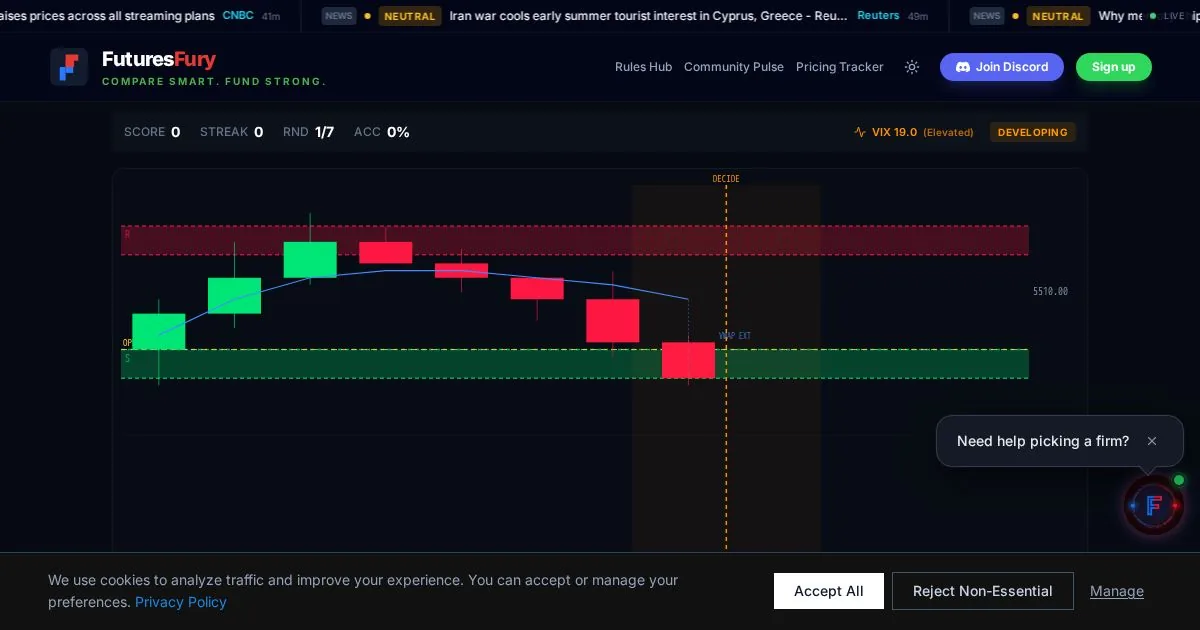
Before every trade, answer three questions: 1) Where is price relative to VWAP? 2) Am I trading into or away from the nearest S/R zone? 3) Does the higher timeframe trend agree with my direction? If you can't answer all three confidently, don't trade. Read our guide to prop firm rules for more on what firms expect.
Why Fake Breakouts Trap Traders
You see price break above a key level. You enter long. Within seconds, it reverses violently and stops you out. Sound familiar?
Fake breakouts — also called liquidity sweeps — are among the most common traps in futures markets. They happen because institutional traders need liquidity to fill their large orders. Retail stop losses clustered above resistance or below support provide that liquidity. The institution pushes price through the level, triggers the stops, absorbs the liquidity, and then drives price in their intended direction.
In an evaluation, falling for fake breakouts is devastating because you're usually entering with momentum and getting stopped out at the worst possible price. Two or three of these in a row can breach your daily loss limit.
Learning to identify and avoid these traps is one of the most valuable skills a futures trader can develop. It's also one of the hardest to practice with real money, which is why simulation tools are invaluable for building this pattern recognition.
The Skill Most Traders Never Learn: Waiting
The most profitable skill in trading isn't reading charts, managing risk, or timing entries — it's the ability to do nothing.
Most market hours are noise. The high-probability setups prop firm evaluations reward happen maybe 2-3 times per session. The traders who pass consistently are the ones who can sit through hours of nothing and only pull the trigger when everything aligns. Every trade you don't take preserves capital and keeps your drawdown buffer intact for the setups that actually matter.
- Track your "patience trades" — document every time you successfully avoided a marginal setup
- Gamify your discipline — use tools like the Do Not Trade Simulator to practice identifying when NOT to trade
- Set an alert system — only watch your charts when price reaches your pre-defined levels
- Compare your best weeks — you'll likely find they coincide with your lowest trade counts
Passing a prop firm evaluation is less about being a great trader and more about being a disciplined one. If you can master overtrading, avoid revenge trades, respect market context, dodge fake breakouts, and learn to wait — you're already ahead of 80% of evaluation takers. New to prop trading? Start with our beginner's guide to the most forgiving firms.
Want to learn which firms give you the most room for these mistakes? Read our Bulenox review for the most forgiving drawdown rules, or our BluSky Trading review for fast payouts that reward patience. For current savings, check active discount codes before you buy.
Frequently Asked Questions
Why do most traders fail prop firm evaluations?
What is the biggest mistake in prop firm evaluations?
How do I stop revenge trading?
What is the best way to prepare for a prop firm evaluation?
Which prop firms are easiest to pass?
Keep Reading
Guides and reviews related to this article
Bulenox Review
one of the most beginner-friendly evaluations
BluSky Trading Review
known for fast payouts and no consistency rule
Is Bulenox Worth It?
quick verdict with pros and cons
What Is Trailing Drawdown?
critical concept for evaluation survival
How to Pass a Prop Firm Evaluation
the complete discipline guide
Trading Discipline Exercises
7 practical drills for futures traders
How to Practice Trading Without Risking Money
the simulator stack that rewires discipline
Prop Firm Skill-Level Decision Guide
pick the right firm for your current skill bracket
Firms Mentioned
Comments (0)
No comments yet. Be the first to share your thoughts!