Prop Firm Consistency Rule Explained (With Examples)
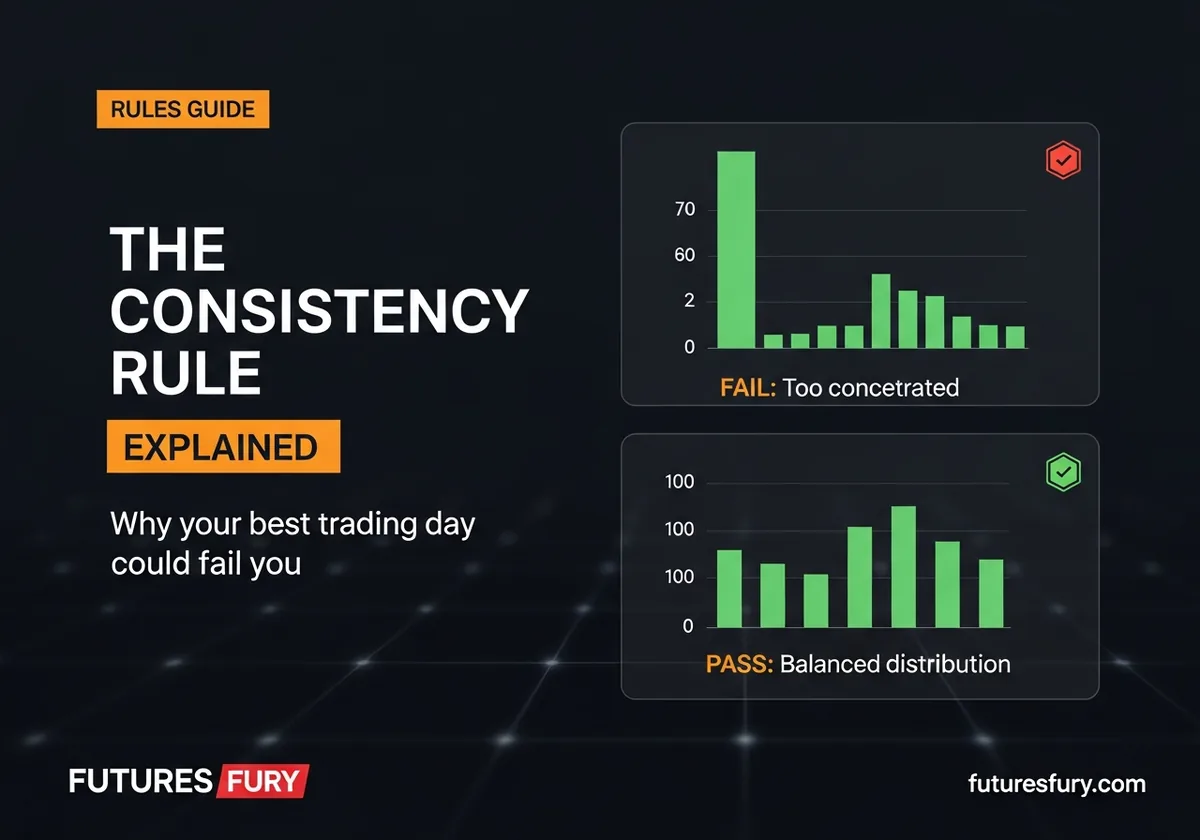
Most traders fail prop firm challenges because of the consistency rule — not drawdown. You hit the profit target, respected every limit, and still got disqualified because one great trading day carried too much of your total profit.
Check Your Numbers
Enter your profit target, the firm's rule percentage, and your best day. The calculator tells you instantly whether you pass or fail:
Consistency Rule Calculator
What Should You Do Next?
Keep your strategy
Your distribution is healthy. Compare firms to find the best fit.
If at riskChoose flexible firms
Pick firms with 40%+ thresholds or no consistency rule.
If you failAvoid consistency rules
Your style doesn’t fit this rule. Use firms without it.
How to Fix a Failing Score
- Trade more days. $3,000 target over 10 days = $900 max/day. Over 15 days = $1,350 max/day. More days = higher ceiling.
- Cap your daily profit at 80% of max. Hit $720 when your cap is $900? Close the platform.
- Front-load small wins. Start with 2-3 modest green days to build a distributed base.
- Switch firms. If your style produces concentrated profits, choose a firm without this rule.
Does This Rule Affect Your Style?
What's Your Trading Style?
Select your style to see if consistency rules affect you.
Deep Dive
How the Consistency Rule Works
Real Example: Pass vs Fail
Why Prop Firms Use This Rule
- One-hit wonders — traders who pass on a single lucky trade, not repeatable skill
- Martingale gamblers — traders who double down after losses until one trade covers everything
- News gamblers — traders who bet big on FOMC/NFP hoping for a directional spike
- The counter-argument: profitable trading is inherently inconsistent. Markets have trend days and range days. The industry is split — half of firms enforce it, half don’t.
Top 5 Ways Traders Accidentally Fail
- They don’t know it exists. Most check drawdown and profit target only. The consistency rule is buried in fine print. Read rules first in the Rules Hub.
- One oversized trade on a trend day. NQ runs 50+ points, you hold for max profit. Eats 40% of your target in one session.
- Revenge trading after a big win. Day 1: $1,000 profit. Days 2-5: break even. Now Day 1 is 80% of total.
- Not tracking daily percentages. You track dollars but not ratios. The only metric that matters is the percentage.
- Rushing the evaluation. Fewer days = lower daily ceiling = easier to violate.
6-Step Strategy to Pass
- Step 1 — Know your ceiling before Day 1. Target / rule % = max daily profit.
- Step 2 — Trade more days. 15 days with a 30% rule gives $1,350 ceiling vs $900 over 10 days.
- Step 3 — Set a hard daily stop-profit at 80% of max.
- Step 4 — Front-load small wins. Build a distributed base early.
- Step 5 — Track running percentages after each session.
- Step 6 — Don’t let runners run unchecked. Near your cap? Take the profit.
Who Should / Shouldn’t Choose These Firms
For a live, ranked list of every firm's consistency rule — filterable by leniency — head to Prop Firms Without a Consistency Rule. The data updates automatically as firms change their rules, so it's always current.
Frequently Asked Questions
What is the consistency rule in prop firms?
How is the consistency rule calculated?
Can you pass a prop firm with one big trade?
Which prop firms don’t have a consistency rule?
Is the consistency rule applied during evaluation or funded?
How do I pass the consistency rule?
Is the consistency rule good or bad?
Keep Reading
Guides and reviews related to this article
Consistency Rule Calculator
test your numbers with coaching output
Top One Futures Review
no consistency rule, simplest evaluation
BluSky Trading Review
no consistency rule, daily payouts
Best Prop Firm for Beginners
complete selection guide
The Real Cost to Get Funded
total cost analysis
Trailing vs EOD Drawdown
the other critical rule
Firms Mentioned
Comments (0)
No comments yet. Be the first to share your thoughts!